

An unexpectedly heart-warming successful appeal
Over the past few weeks we have had multiple successful AAT appeals overturning visa refusals from the Department of Home Affairs. These include 485s, 600 visitor visas and 500 student visas, as well as extremely long-pending 187s.
To be honest, every case overturned on appeal is hard won — submissions of several thousand words and supporting materials running into hundreds of pages are routine.
Today we want to share a heart-warming and unexpected successful appeal.
A small mistake is enough to cause a refusal with lasting consequences
This successful appeal was for a visitor visa. The case itself was not complicated, but the tribunal member’s warm-hearted approach left a strong impression on us, and reminded us that beyond the hard work and nerves-on-edge nature of this profession, there is also a great deal of fulfilment and satisfaction.
The client was an elderly gentleman from Shanghai. He had previously tried to renew his visitor visa on his own, but because of a delay in the BPay payment arriving, the application could not be lodged successfully. He later lodged a paper application, but because of his overstay history, he could not meet PIC 3004 and was refused.
The threshold for a waiver of clause 3004 is very high — you need to prove that factors beyond your control caused the late lodgement of the renewal application.

The article about verifying advice given by the Department of Home Affairs before relying on it was inspired by this client’s experience (see image below).

Give the appeal our best shot, but prepare for the worst
The elderly gentleman and his wife had been in Australia with their daughter and grandchildren, and he also suffers from an eye condition, so his wife needs to accompany him whenever he enters or leaves the country. His wife had lodged her application and paid one day earlier, so her visa was granted. But if his appeal failed, he would have to leave Australia within 35 days. Given the situation, even if he could buy a ticket, travelling alone would be extremely difficult for him.
After being engaged, we did everything we could to prepare the materials, and in the submission we set out his current predicament in detail. We even asked in the closing that, if the tribunal upheld the original decision, whether it could take the practical circumstances into account and slightly delay the date of the decision, so that he would have some time to buy a ticket and arrange his affairs at home.
Even so, we told the gentleman and his daughter to prepare themselves mentally, because an AAT member’s decision has to be based on law, and on our view of the facts it was going to be difficult to argue that any factors beyond his control caused the late lodgement.
After the hearing started, the first half went much as we expected: the member pointed out that the BPay terms clearly state that if the visa expires within 3 days, this payment method should not be used. The invoice also gave a clear reminder.
At that point, the situation seemed unfavourable to us.
Then the tide turned
However, the situation then took a dramatic turn. During the subsequent statement of facts, the gentleman mentioned his eye condition, and rather than brushing past it, the member took the applicant’s perspective and probed and questioned the issue in depth:

In the end there was a turnaround right there in the hearing room, with the member making an oral decision on the spot in favour of the applicant.
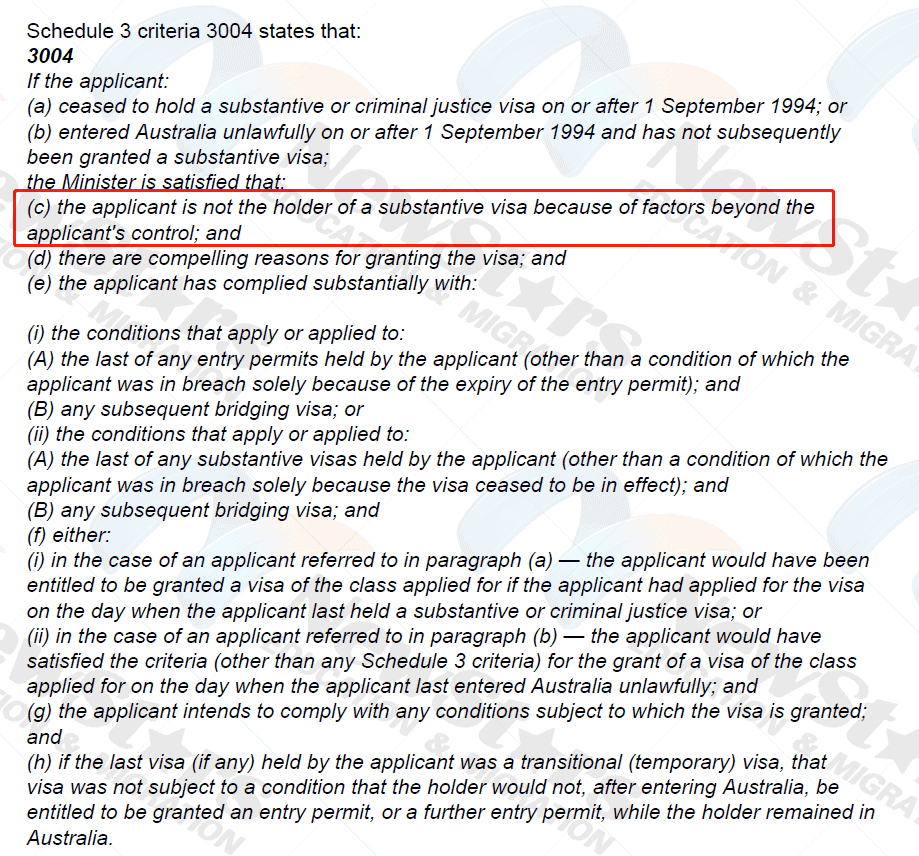
Because of his eye condition, the whole application process was not entirely within his personal control, and responsibility did not rest solely with him. The applicant therefore satisfied the relevant requirements of PIC 3004, and the Department of Home Affairs was to reconsider the application.

This decision made both the client and us very happy, and gave us a deeper appreciation of the idea that the law is not without compassion.
Within the powers given to them by law, the member was willing to fully understand the facts and, on the basis of those facts, actively help us find a legal footing for the applicant so that he could lawfully meet the requirements and continue to be reunited with his family in Australia.
At the end of the hearing, the gentleman’s whole family expressed their gratitude to the member, and I also thanked the member for her in-depth exploration of the facts and holistic consideration of the applicant’s personal circumstances.
Although this visitor visa case was not itself complex, being involved from start to finish, witnessing the kinder side of human nature along the way and helping the client achieve the outcome they hoped for was a very fulfilling experience.
Once again a reminder: no visa matter is trivial. Even for what looks like a “simple” visitor visa for the parents of a PR or citizen, one small misstep wastes effort and money, and even if the end result is what you wanted, you have added unnecessary trouble to the process.
The AAT has been processing student visa, 485 and visitor visa appeals quickly recently.
Successful 485/500 appeals
For example, a 485 visa case we won a few days ago went from lodgement to hearing in about a month, and visitor and student visa appeals are also generally being heard within a few months.

We have also recently had a number of successful 500 student visa appeals.


187 employer sponsorship appeal
However, appeals for skilled migration, partner migration and employer sponsorship visas are still being processed more slowly.
For example, a recent decision on a 187 regional employer sponsorship appeal took 3 years and 1 month!
The 187 category has now been replaced by the 494. At the time, because of issues on the employer’s side, the client did the nomination themselves and engaged us only for the visa application. However, due to the employer’s oversight, the deadline for responding to a request for more information was missed, the nomination was refused, and the nomination had to be appealed. Because the nomination was refused, the 187 visa could not be approved either, so both applications had to be appealed at the same time.
After waiting 3 years and 1 month, we were notified last month to provide pre-hearing supplementary material. We prepared and submitted nearly 400 pages of submission and supporting evidence.


Just over a month later, the Department of Home Affairs handed down its decision (set aside a decision and substitute a new decision) and approved the employer’s nomination.

So anyone currently going through an appeal really must prepare thoroughly in light of the changes in how AAT appeals are being processed. With thorough preparation, there is every chance of securing a result on the spot like the case at the start of this article!
AAT appeals are being processed faster recently:
One reason is that the AAT has increased its number of members, and for the time being hearings are still being conducted mainly online or by phone, which also helps speed things up.
Many of the refusal cases we have been asked to help with recently are quite “unfair”:
Including many of the applications we have successfully appealed, quite a few clients were refused after DIY attempts because of very small mistakes, especially in what everyone assumes are simple visitor visa, 485 and student visa cases — for example failing to respond in time to a case officer’s request for more information, medical examinations or police checks not being done on time, forgetting to buy insurance and then missing the Department of Home Affairs’ notice, or ticking the wrong option or choosing the wrong stream in the online form.
Every time we see these mistakes we feel it is such a pity. Leaving aside whether the appeal will ultimately s\ucceed, even a successful appeal costs an application fee of A$3,000, far more than the application fee for the visa itself, let alone the other costs such as the time and energy involved. Visa processing is already slow, and going through this on top of that is an unnecessary ordeal.
So it has been said a thousand times: no visa matter is trivial — please engage a professional to help!

Finally, a quick explainer — AAT decisions generally fall into three categories:
Reaffirm means the AAT upholds the Department of Home Affairs’ original decision;
Remit means the AAT considers that the applicant has met certain requirements and sends the case back to the Department of Home Affairs for reconsideration. This is common in visa applications; if any materials have expired during the reconsideration, updated materials will still need to be resubmitted;
Substitute means the AAT directly replaces the Department of Home Affairs’ decision with its own approval.


